Part-Time High School Enrollment
Access Rivermont's rigorous college-preparatory curriculum, Advanced Placement courses, and expert instruction, one course at a time.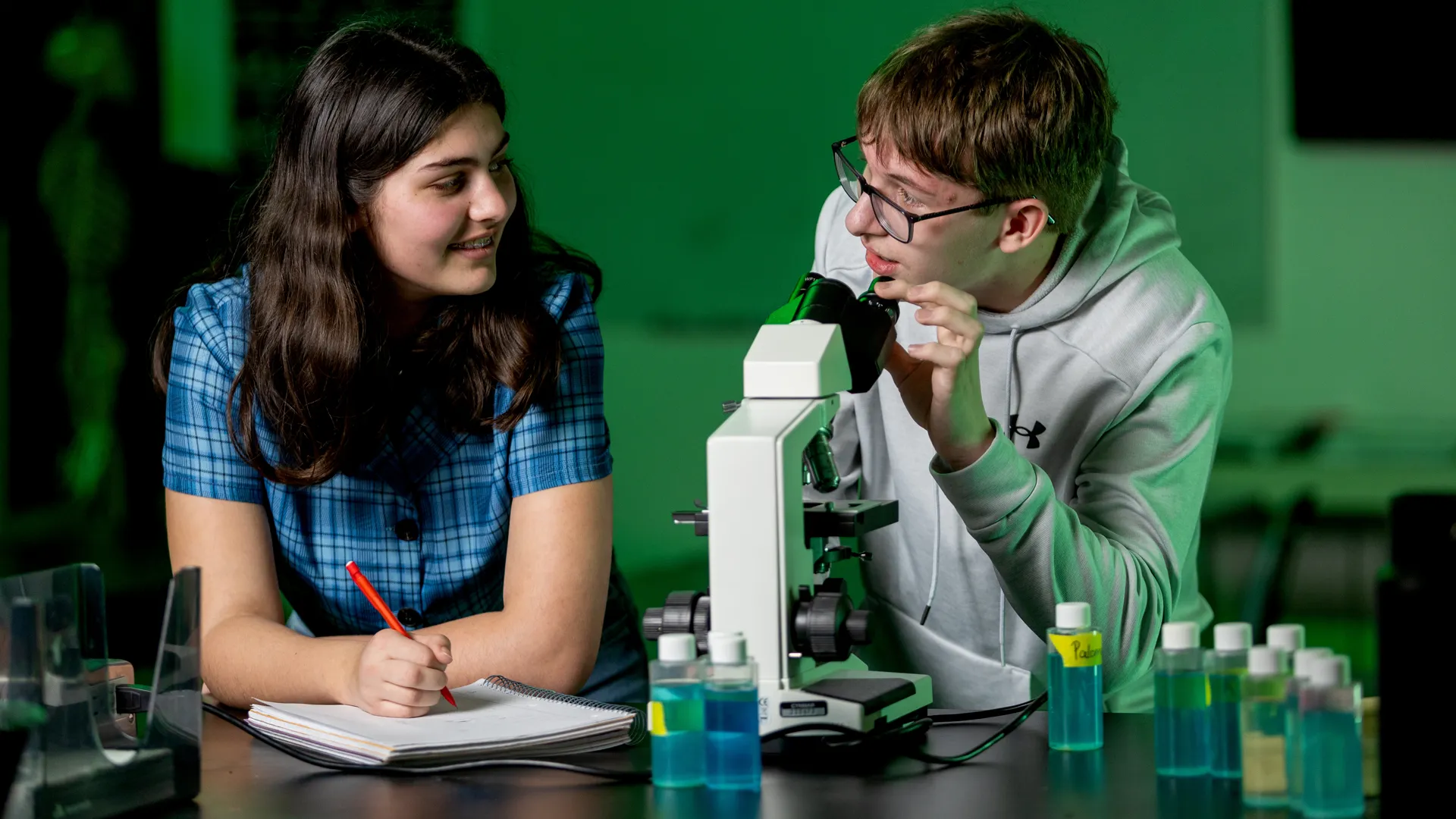
Expand your educational opportunities with Rivermont Collegiate Part-Time High School Enrollment. Students in grades 9-12 may enroll in select Rivermont courses without attending the school full-time. Designed for homeschool students and other motivated learners, the program offers access to rigorous college-preparatory instruction, Advanced Placement courses, STEM offerings, specialized electives, and college counseling.
Part-time students learn alongside Rivermont’s full-time students and benefit from the same expert faculty, small classes, and a supportive learning environment. Courses cost $1,000 each, with enrollment based on course availability and successful completion of Rivermont’s admissions process.
Whether you’re seeking advanced coursework, college preparation, or opportunities unavailable at your current school, Rivermont Part-Time High School Enrollment provides a flexible pathway to an exceptional educational experience.
Contact Admissions
Office Ph: 563-359-1366
Send an Email
Contact Admissions
Course Catalog
Don’t see the course you’re looking for? We encourage families to inquire even if a desired course is not currently listed in the course catalog. Rivermont works closely with students and families to understand their academic goals, and additional course offerings may be available based on student interest, scheduling, and faculty availability. If there is a particular subject, Advanced Placement course, or area of study you would like your student to pursue, we invite you to contact our Admissions Office to discuss the possibilities.
ENGLISH
9 – Pre AP English 1
Pre-AP English 1 is a course for ninth graders that combines literature, composition, and presentation skills. In literature, students focus on important works by modern American and global authors. We aim to include diverse cultures through the authors and through literary fiction and nonfiction genres in our curriculum. Pre-AP English 1 teaches students to read, interpret, and write about literature and composition. While analyzing and writing about literary texts is the main goal, there is also an emphasis on understanding cultural and historical texts. More specifically, the course centers on textual analysis, preparing students for close, critical reading and analytical writing. It trains students to notice small details in a text, helping them develop a deeper understanding of the overall message. It also helps students learn to create complex sentences, which builds a foundation for more sophisticated, longer analyses, while encouraging active engagement with texts, writing, language focus, research, and participation in conversations. Readings might include challenging classics such as Dr. Martin Luther King Jr.’s “Why We Can’t Wait” or Sophocles’ “Antigone.” Excerpts from Shakespeare’s “Romeo and Juliet” will also be examined. Students will be encouraged to prepare and present research individually, showcasing their oral communication skills. Team-building exercises, as well as reading and writing exercises, will help boost their confidence in various speaking, reading, and writing situations. Ninth graders will receive explicit, research-based instruction that is systematic in approach. Pre-AP English 1 introduces students to key communication elements, including vocal production and listening skills. Students will learn to write argumentative essays and cite their sources correctly.
10 – Pre-AP English 2
In Pre AP English 2, students engage with a wide range of literature, including novels, short stories, plays, and poetry. Readings include works by William Shakespeare, John Steinbeck, Gabriel García Márquez, Julio Cortázar, Ursula K. Le Guin, Shirley Jackson, and Gwendolyn Brooks, among others. Through close reading and analysis, students will explore literary and poetic devices while refining their writing skills. Assignments include analytical essays, personal narratives, and creative writing pieces. Grammar and vocabulary instruction are incorporated throughout the course to support student growth in both written and spoken expression.
11 – AP Language & Composition
The AP Language and Composition course offers students opportunities to enhance their skills in reading a variety of print and visual, literary texts, responding critically to what they read, analyzing the rhetorical strategies that authors employ to develop their claims and themes, and evaluating texts based on their persuasiveness, significance, and historical insights. AP English Language and Composition aligns with an introductory, college-level rhetoric and writing curriculum. The course emphasizes developing and revising evidence-based analytical and argumentative writing and the rhetorical analysis of nonfiction texts. It also helps students improve their ability to write more effectively for various purposes and audiences, particularly in contextualizing, explaining, analyzing, and persuading through their written essays. Ultimately, the course deepens students’ understanding of themselves and their culture by providing opportunities to read, discuss, and respond in various ways to diverse print and visual texts on relevant topics such as education, American politics, the international environment, popular culture, the media’s influence on society, American diversity and values, and major institutions in American life, including but not limited to religion and government.
SOCIAL STUDIES
9/10 –AP World History: Modern
AP World History: Modern is an introductory college-level modern world history course. Students cultivate their understanding of world history from c. 1200 CE to the present by analyzing historical sources and learning to make connections and craft historical arguments as they explore concepts such as humans and the environment, cultural developments and interactions, governance, economic systems, social interactions and organization, and technology and innovation.1
1https://apcentral.collegeboard.org/courses/ap-world-history
*This class will alternate each year with AP Human Geography
11/12 – AP US History
AP U.S. History is an introductory college-level U.S. history course. Students cultivate their understanding of U.S. history from c. 1491 CE to the present through analyzing historical sources and learning to make connections and craft historical arguments as they explore concepts like American and national identity; work, exchange, and technology; geography and the environment; migration and settlement; politics and power; America in the world; American and regional culture; and social structures.
11/12 – AP Comparative Government and Politics
In the AP Comparative Government and Politics course, you’ll examine the political systems and government structures of China, Iran, Mexico, Nigeria, Russia, and the United Kingdom. Throughout the course, you’ll learn how different governments address similar challenges and develop a clear understanding of the comparative method through the analysis of data and text-based sources, making thoughtful comparisons, and constructing evidence-based arguments. Additionally, you’ll connect political theories to real-world situations by comparing various political systems, institutions, processes, policies, and behaviors, identifying trends and patterns in data, and developing well-supported claims or theses in your essays.
11/12 – AP Government & Politics (S2)
In the AP U.S. Government and Politics course, you’ll delve into the dynamics among the President, Congress, and the Supreme Court, and explore how various political ideologies influence American politics. You’ll apply political theories to real-life scenarios, assess the impact of landmark Supreme Court decisions, and analyze data to uncover patterns and trends. Additionally, you’ll examine both written and visual sources, ultimately crafting well-supported essays that present a clear thesis.
SCIENCE
9 – Biology
Biology is a basic survey course designed for 9th graders to get an overview of many disparate biology topics. We start with ecology and evolutionary biology concepts, then spend time on biochemistry and the structure of the cell. We also cover basic functions of DNA and RNA, how cells divide and reproduce, heredity and genetics, and a summary of human organ systems and development. The study of life is huge and complex, and we try to hit the highlights with a focus on preparation for more advanced study in college.
10 – Chemistry
Our chemistry curriculum closely mirrors a streamlined version of a one-semester college chemistry course. Students will learn how to write, name, and discuss various chemicals, how to work with solutions and gases, and how energy is transferred, with an emphasis on the mathematical relationships that describe various processes. Students will also learn to work with chemical equations to represent reactions, and about acids, bases, and equilibrium. We finish the year with an introduction to organic chemistry, and, time permitting, either electrochemistry or nuclear chemistry.
11/12 – AP Biology
This is an advanced survey course on biology with an emphasis on preparing for the College Board’s AP Biology exam. This will largely mirror the topics discussed in our standard biology class, but with each topic presented in more depth. Units range from the study of biochemical pathways to ecosystem interactions.
11/12 – AP Physics 1
Physics is a discipline that seeks to describe and predict the behavior of the universe in mathematical terms. The course culminates with an optional AP test, which allows students to apply the credits earned toward their undergraduate degree. The core concepts covered include kinematics, forces, work & energy, momentum, rotational dynamics, harmonic oscillators, and fluids. Overall, students will gain a deeper understanding of how the universe functions at a fundamental level, as well as the mathematical tools used to describe it. Satisfactory completion of Algebra 1 is a prerequisite for enrollment in this course.
11/12 – AP Psychology
Why do humans do what we do and think what we think? What is mental illness – how is it diagnosed and treated? What role do situational factors play in shaping individual behavior? Psychology helps answer these questions. Psychology is the systematic, scientific study of behavior and mental processes. Over the year, students will be exposed to major thinkers, famous experimental studies, key concepts, and methods in psychology. This class is designed to simulate the experience of taking an introductory-level course in psychology in a college setting and will culminate in the opportunity to take the Advanced Placement exam for psychology.
MATH
AP Precalculus
AP Precalculus combines concepts of trigonometry, geometry, and algebra that are needed to prepare students for the study of calculus. The course strengthens students’ conceptual understanding of problems and mathematical reasoning in solving problems. Facility with these topics is especially important for students who intend to study calculus, physics, other sciences, and engineering in college. The main topics in the AP Precalculus course are complex numbers, vectors, matrices, polar coordinates, as well as exponential, polynomial, rational, and trigonometric functions and their inverses. This course culminates with an optional AP exam, which students may use for college credit or undergraduate math placement, depending on their specific program.
AP Calculus AB
AP Calculus AB focuses on students’ understanding of calculus concepts and provides experience with methods and applications. Through the use of big ideas of calculus (e.g., modeling change, approximation and limits, and analysis of functions), the course becomes a cohesive whole, rather than a collection of unrelated topics. Students will use definitions and theorems to build arguments and justify conclusions. The course features a multi-representational approach to calculus, with concepts, results, and problems expressed graphically, numerically, analytically, and verbally. Exploring connections among these representations builds understanding of how calculus applies limits to develop important ideas, definitions, formulas, and theorems. A sustained emphasis on clear communication of methods, reasoning, justifications, and conclusions is essential. AP Calculus AB is designed to be the equivalent of a first-semester college calculus course devoted to topics in differential and integral calculus, including limits, derivatives and their applications, and integrals and some of their applications. The course will culminate with the opportunity to take the Advanced Placement exam.
AP Calculus BC
AP Calculus BC focuses on students’ understanding of calculus concepts and provides experience with methods and applications. Through an exploration of the big ideas of calculus (e.g., modeling change, approximation and limits, and analysis of functions), the course becomes a cohesive whole, rather than a collection of unrelated topics. Students will use definitions and theorems to build arguments and justify conclusions. The course features a multi-representational approach to calculus, with concepts, results, and problems expressed graphically, numerically, analytically, and verbally. Exploring connections among these representations builds understanding of how calculus applies limits to develop important ideas, definitions, formulas, and theorems. A sustained emphasis on clear communication of methods, reasoning, justifications, and conclusions is essential. AP Calculus BC is designed to be the equivalent of a first two semesters college calculus course devoted to topics in differential and integral calculus, including limits, derivatives and their applications, integrals and their applications, parametrically defined curves, polar curves, vector-valued functions, and introduces the topics of sequences and series. The course will culminate with the opportunity to take the advanced placement exam.
TECHNOLOGY
AP Computer Science Principles
AP Computer Science Principles introduces students to the breadth of computer science. In this course, students will learn to design and evaluate solutions and to apply computer science to solve problems through the development of algorithms and programs. They will incorporate abstraction into programs and use data to discover new knowledge. Students will also explain how computing innovations and computing systems, including the Internet, work, explore their potential impacts, and contribute to a computing culture that is collaborative and ethical. AP Computer Science Principles is equivalent to an introductory, college-level breadth course in computer science and will culminate with the opportunity to take the Advanced Placement exam.
FINE & PERFORMING ARTS
US Elective: 2D Art (S1)
2D Art is a hands-on art course where students learn how to create artwork on flat surfaces while building strong foundational skills. Students will explore drawing, painting, collage, printmaking, and mixed media while learning how artists use line, value, color, texture, space, and composition to communicate ideas. Through guided lessons and creative projects, students will turn ideas into a variety of finished pieces throughout the course.
US Elective: Advanced Art/AP Drawing (S2)
Advanced/AP Art is a portfolio-based, inquiry-driven course for highly motivated students who want to grow their art skills and push their ideas further. Students should have completed Drawing I, Painting I, or have prior art experience. In this semester course, students create a body of work that includes finished pieces, process work, and written reflections, preparing for future AP portfolio submission or, if ready, submitting an AP portfolio.
9 – Great Works of Art Sequence
In this unique class required of all ninth-graders, students will be exposed to great writing, fine arts, music, and film. Each quarter is taught by a different instructor and exposes students to the most important genres, artists, and specific works within each of the four subfields. Students will leave the course with a better understanding of what makes a work of art timeless and an appreciation for how classic works of art continue to speak to the human condition and influence cultures and societies to this day.
COLLEGE COUNSELING
11 – Junior Seminar (S2)
Students will gain a better understanding of the college and career search, application, and decision processes. Students will fully complete a resume. Attendance at two presentations from admission counselors who visit Rivermont will be required. Students should begin to visit college campuses as well.
12 – Senior Seminar (S1)
By the time the first semester of senior year is over, it is expected that students will have applied to at least six colleges (two safety, match, and reach) and will have filed the FAFSA and/or CSS Profile (dependent on circumstances). These will be worked on during Senior Seminar. Information on scholarships and early decision will also be discussed.